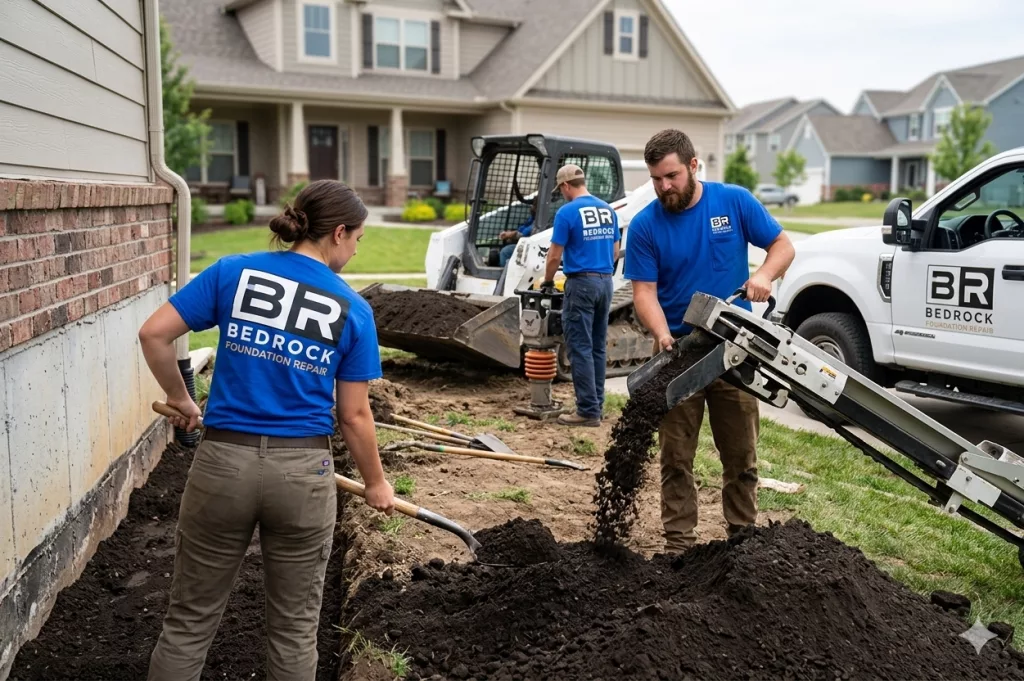
The Critical Role of Fill Dirt in Foundation Health
Fill dirt is not just used to fill holes. We use specific soil mixtures—often high in clay content—to create a dense, stable barrier that regulates moisture and prevents erosion around your concrete slab or pier-and-beam foundation.
- Correcting Grading and Sloping
Poor drainage is the number one enemy of a foundation. If your yard slopes toward your structure, rainwater will pool against the concrete, softening the supporting soil.
- Residential: We add fill dirt to create a gentle, downward slope away from your home’s perimeter, safely directing roof runoff into the yard or drainage systems.
- Commercial: For large commercial buildings, warehouses, or multi-family complexes, we grade the surrounding earth to ensure massive amounts of stormwater runoff bypass the foundation entirely.
- Backfilling After Excavation and Tunneling
When our teams perform deep foundation repairs—such as installing steel or concrete piers—we must excavate the soil beneath and around the structure.
- Once the piers are securely driven and the building is leveled, we do not just loosely throw the dirt back in.
- We use high-quality fill dirt to pack the excavated areas tightly.
- Every layer is mechanically compacted to eliminate air pockets and prevent the soil from settling later.
- Eliminating Low Spots and Ponding
Over time, the soil around a property naturally erodes, creating low spots or “bird baths” near the foundation. These depressions trap water, allowing it to seep straight down into the subgrade. We utilize dense fill dirt to level out these low points, ensuring uniform moisture levels in the soil across the entire perimeter.
- Preventing Sub-Slab Erosion
Heavy storms can wash away the critical soil holding up your sidewalks, driveways, and foundation edges. By packing fill dirt into these eroded voids, we reinforce the perimeter and shield the foundation’s footprint from further weathering.
Our Commercial & Residential Process
- Topographical Assessment: We inspect the property to locate drainage failures, low spots, and signs of soil erosion.
- Material Selection: We source high-density fill dirt that matches the specific compaction needs of your property’s footprint.
- Layered Compaction: Dirt is applied in controlled intervals and heavily compacted to ensure it remains stable against the elements.
- Final Grading: We finish the surface with a precise slope, leaving the site ready for final landscaping, mulch, or sod.
Free Home Inspection
Fill out our quick online form or call us today to book your 100% free, no-obligation structural inspection.