What is Mudjacking?
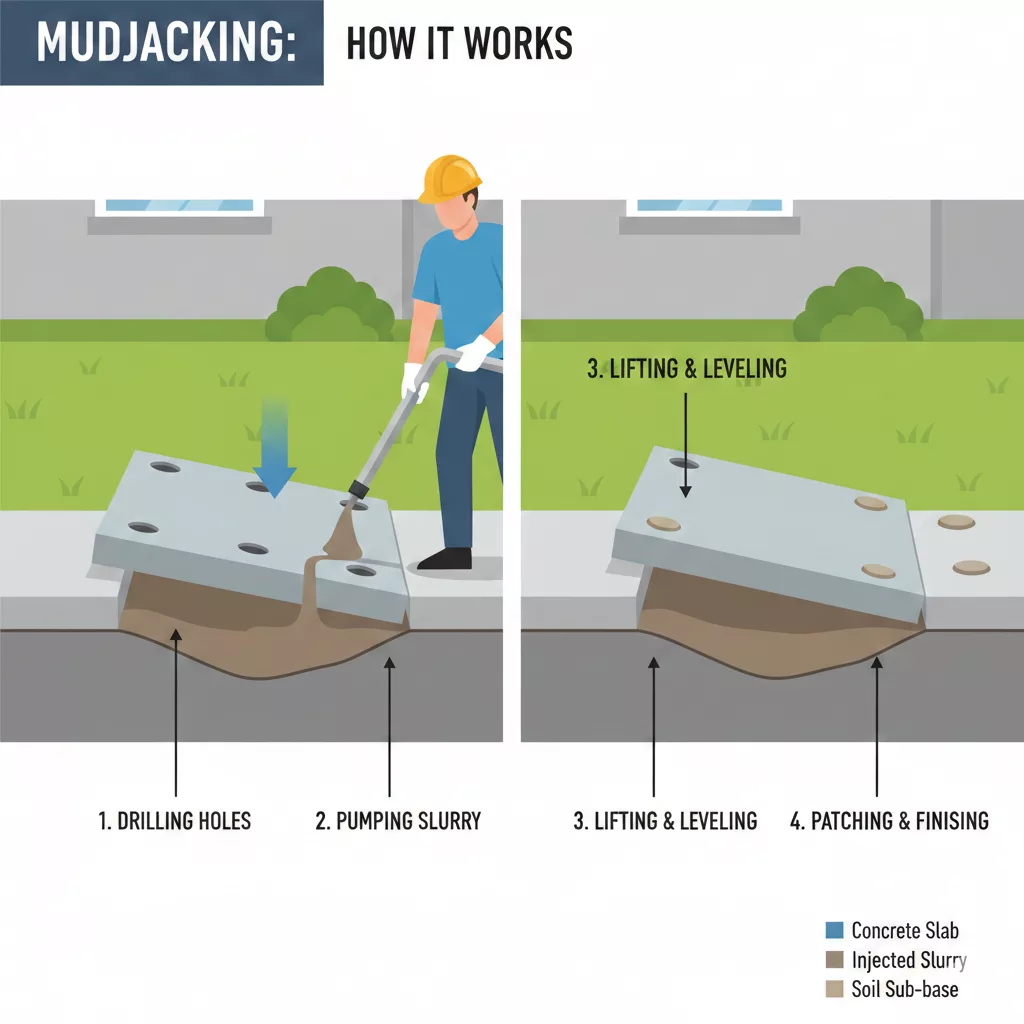
Mudjacking (also known as slab leveling or pressure grouting) is a process used to raise sunken concrete slabs by pumping a grout-like “slurry” underneath them.
How it works:
- Drilling: Small holes (usually about 1–2 inches in diameter) are drilled through the sunken concrete slab.
- Pumping: A mixture of water, soil, sand, and cement is pumped through these holes under high pressure.
- Lifting: As the mixture fills the void beneath the slab, it creates upward pressure, lifting the concrete back to its original position.
- Patching: The holes are filled with concrete, and the job is done.
Why Do You Need It?
Concrete doesn’t usually sink because the concrete itself is bad; it sinks because the ground beneath it has failed. You might need mudjacking if you are dealing with:
- Soil Erosion: Water from leaky gutters or poor drainage has washed away the dirt under your patio or walkway.
- Soil Compaction: If the ground wasn’t properly packed down before the concrete was poured, it will eventually settle under the weight.
- Safety Hazards: Uneven concrete is a major tripping hazard. In many municipalities, a height difference of even $1/4$ inch can make you liable for injuries.
- Preventing Further Damage: If a slab is tilted toward your house, it can direct water into your foundation or basement, leading to much more expensive repairs.
Mudjacking vs. Total Replacement
| Feature |
Mudjacking |
Replacing Concrete |
| Cost |
Usually 50% cheaper |
Full price of labor + materials |
| Time |
Done in a few hours |
Takes days (demo, pour, cure) |
| Mess |
Minimal |
Significant (heavy machinery, dust) |
| Landscaping |
Your grass stays intact |
Expect ruts and torn-up turf |