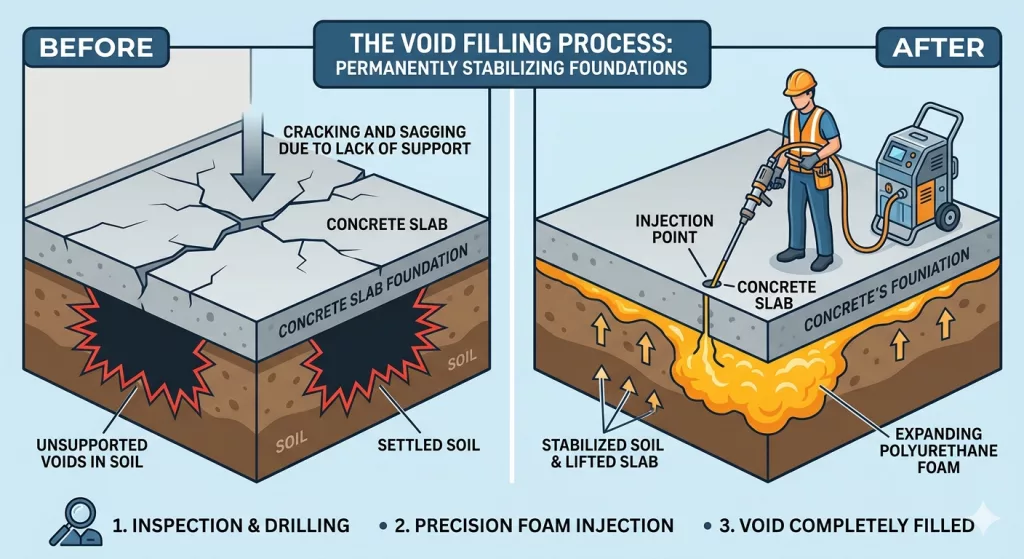
Professional Void Filling: Securing the Earth Beneath Your Home
Soil erosion, decaying organic matter, and broken plumbing can all lead to a hidden danger: underground voids. These empty pockets beneath your concrete slabs or foundation deprive your home of its necessary support, leading to sudden sinking and structural failure. Void filling is the specialized process of identifying these hollow spaces and packing them with high-density materials to restore total ground contact.
How Void Filling Protects Your Property
Unlike simple “patching,” professional void filling addresses the root cause of instability:
- Structural Re-Support: By replacing air with solid material, we restore the load-bearing capacity of your foundation.
- Erosion Prevention: Filling voids stops water from traveling freely under your home, preventing further soil wash-out.
- Prevention of Costly Collapses: Addressing a small void today prevents a total slab collapse or catastrophic foundation break tomorrow.
Why Bedrock Foundation Repair, LLC is the Top Choice for Void Filling
When it comes to the ground beneath your home, “close enough” isn’t good enough. Bedrock Foundation Repair, LLC is the industry leader in precision void filling because we combine advanced technology with a deep understanding of local soil mechanics.
The Bedrock Advantage: Advanced Density Mapping & Material Selection
We don’t just “blindly” pump material underground. Our team uses diagnostic tools to map the extent of the hollow spaces, ensuring every cubic inch is accounted for. While others might use heavy, outdated mud-jacking slurries that can actually cause more sinking, Bedrock utilizes lightweight, high-strength polymers and specialized grout mixes designed to provide maximum support without adding unnecessary weight to the soil.
With Bedrock Foundation Repair, LLC, you get a permanent, surgical-grade solution that stabilizes your home for the long haul.
Signs You Have Voids Under Your Foundation
- “Hollow” Sounds: A distinct echoing or hollow sound when walking on or tapping concrete slabs.
- Sinking Concrete: Driveways, garage floors, or patios that appear to be dipping into the earth.
- Sudden Cracking: New, large cracks appearing in a slab without a clear external cause.
- Soil Depressions: Visible “sinkholes” or low spots in the dirt immediately adjacent to your foundation.
Why Would You Need It?
You usually won’t go looking for pressure grouting unless a structural engineer or a savvy contractor points out a problem. Here are the “Red Flag” scenarios where it becomes necessary:
1. Your Foundation is Sinking (Settlement)
If your house is doing its best impression of the Leaning Tower of Pisa, you might have soil gaps beneath your slab. Pressure grouting (specifically “compaction grouting”) can fill those gaps and actually lift the slab back to its level position.
2. Soil Stabilization
Sometimes the dirt under your driveway, pool deck, or commercial building is just too loose or sandy to support the weight. Pressure grouting binds that soil together, turning it into a solid, stable “block.”
3. Water Leaks and Seepage
If water is entering your basement through cracks in the foundation or if a retaining wall is failing due to hydrostatic pressure, chemical grouting can be used. This type of grout reacts with water to expand and create a waterproof seal.
4. Filling Voids (Sinkholes)
If a localized sinkhole or a “void” has formed under a structure (common in areas with limestone or old utility lines), pressure grouting is the go-to method to fill that cavity before the ground collapses.
The Benefits: Why Not Just Replace the Concrete?
- Cost-Effective: It is significantly cheaper than tearing out an entire foundation or floor and pouring new concrete.
- Non-Invasive: You don’t need heavy excavators or a massive construction crew. The “footprint” is small—just a few drill holes.
- Speed: Most residential jobs can be finished in a single day, and you can usually walk on the surface almost immediately.
A Quick Tip: If you’re noticing cracks in your drywall or doors that won’t close properly, don’t wait. These are the “check engine lights” for your foundation.
Would you like me to help you figure out which type of grout—cement-based or chemical—is best suited for a specific project you’re working on?